Akoya vs Freshwater Pearls: What's the Difference and Which Should You Buy?
There's a moment every pearl buyer reaches: you've decided you want pearls. You just don't know which pearls.
Akoya or freshwater. Round or baroque. 5mm or 8mm. The options multiply quickly, and most of what you find online is either too technical or quietly trying to sell you the more expensive option.
This isn't that kind of guide.
We make both. We'll tell you exactly when to choose each — and show you the difference on a real person, not a product shot.
What Are Akoya Pearls?
Akoya pearls are cultured in Pinctada fucata martensii oysters, primarily in the cold coastal waters of Japan. They have been the standard for classic pearl jewellery since the early 20th century — the pearl Audrey Hepburn wore, the pearl your grandmother inherited.
Key characteristics:
- Luster: Mirror-like, high-reflective surface. You can often see your own reflection in a fine Akoya pearl.
- Shape: Consistently round — the most symmetrical of all pearl types.
- Size range: Typically 5–10mm. Anything above 9mm is considered exceptional.
- Colour: White with pink (rose) or cream overtones. The pink overtone — called rosé — is highly prized.
- Nacre thickness: Dense and fine-grained, which is the structural reason for the superior luster.
What Are Freshwater Pearls?
Freshwater pearls are cultured in mussels (Hyriopsis cumingii) in lakes and rivers, primarily in China — though the best freshwater pearls today rival Akoya in quality.
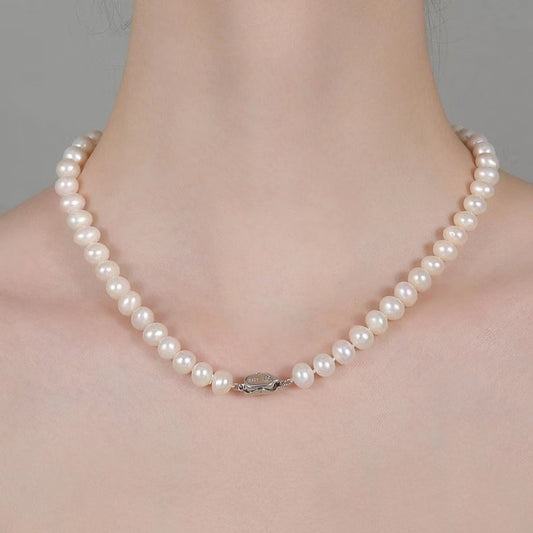
Unlike Akoya pearls, freshwater pearls are almost entirely made of nacre (no bead nucleus), which means they're incredibly durable and don't chip or peel the way some people fear.
Key characteristics:
- Luster: Softer, more diffused glow — described as "inner light" rather than a mirror surface.
- Shape: Wide variety — round, near-round, baroque, drop, coin. The irregularity is part of the beauty.
- Size range: 4–16mm. Much wider range than Akoya.
- Colour: White, cream, peach, lavender, and natural metallics.
- Nacre thickness: Thicker overall — the entire pearl is nacre, not a bead coated in it.
The Honest Difference: Luster
This is the real question. Not price. Not prestige. Luster.
Akoya luster is sharp and reflective. Hold an Akoya stud up to the light, and you'll see your face reflected back — slightly distorted, like looking into a very small, perfect mirror. This is why they photograph so brilliantly and catch the eye from across a room.
Freshwater luster is warm and glowing. It doesn't reflect as sharply, but it emanates light from within. On skin, especially in candlelight or golden-hour sun, freshwater pearls have an almost otherworldly softness.
Neither is better. They are genuinely different moods.
Which Should You Choose?
| If you want… | Choose… |
|---|---|
| Maximum luster and "classic pearl" look | Akoya |
| Everyday durability, wider size/shape options | Freshwater |
| Earrings that catch light from across a room | Akoya |
| A necklace with unique, organic character | Freshwater baroque |
| A bridal or formal piece | Akoya |
| Something you'll wear with a white T-shirt | Freshwater |
| A first pearl gift under £150 | Freshwater |
| A milestone gift or heirloom piece | Akoya |
What She's Wearing in Our Campaign Image
The model in our latest campaign is wearing both — intentionally.
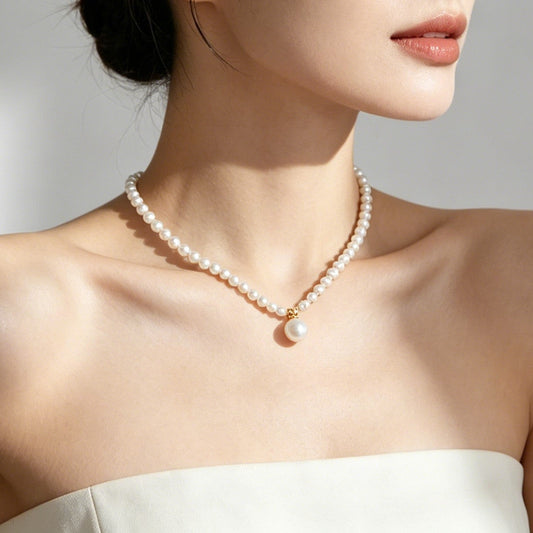
Sawa Necklace — freshwater pearl strand with a single baroque drop, hand-knotted in 925 silver. The strand pearls are near-round freshwater, which gives the necklace its soft, wearable quality. The drop pendant is a single baroque pearl — no two are identical.
Akoya Pearl Studs (7mm) — Japanese Akoya, round, white with a rose overtone. At 7mm, they sit confidently on the ear without being oversized. The luster is why they read so clearly in photographs.
The pairing works because freshwater and Akoya complement rather than compete. The necklace grounds the look; the studs lift it.
A Note on Size
5mm feels delicate and barely-there — perfect for daily wear, layering, or those who prefer jewellery that whispers.
7mm is the classic choice — noticeable, elegant, versatile from boardroom to dinner.
9mm makes a statement. Worn alone, it commands attention.
If you're unsure, 7mm is the answer almost every time.
The Kikyo Approach to Pearl Grading
We source to AAA and AAAA grade — the top two tiers of the industry grading system. This means:
- Surface: fewer than 5% blemishes visible to the naked eye
- Luster: bright, sharp reflection with deep overtone
- Shape: round within 2% variance (for round pearls)
- Matching: consistent size and colour within strands
We don't sell AAA pearls as AAAA. The difference is real, and so is the price — which is why we show both grades and let you choose.
Final Thought
The best pearl is the one you'll actually wear.
For most people, that means a freshwater strand for every day and Akoya studs for whenever you want the room to notice. That's exactly why we designed the Sawa Edit — both pieces, both moods, one woman.
→ Shop the Sawa Necklace → Shop the Akoya Pearl Studs
Kikyo Pearl London sources all pearls directly from certified farms in Japan and China. Every piece is hand-inspected before dispatch from London.